If you decide to study, check: Is the institution accredited as a university? Are their degrees recognized by the state? Are the degree programmes regularly reviewed and accredited by external experts? Only if this is the case should the institution be worth your time or money. The Merz Akademie fulfils all these criteria and is also accredited by the deutscher Wissenschaftsrat - an extra-hard test and a label of quality that no state university can offer.
2
Personal
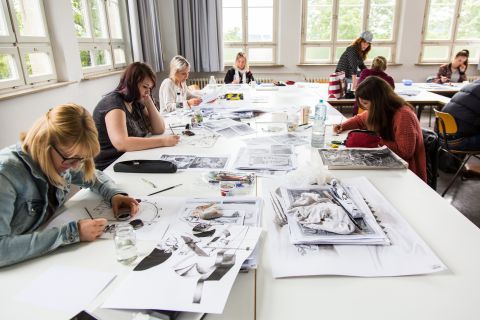
The personal contact to each person is important to us. This starts with student consultation and is also reflected in the curriculum. Up to 25 semester hours per week, during which you have direct contact with professors and lecturers, are quite normal for Bachelor's studies at the Merz Akademie. In addition, there are employees from the workshops, study office and administration who are always ready to listen if you have any questions or problems.
In the Bachelor of Arts program, you can put together your own individual modules from the Emerging Media, Film and Video, New Media and Visual Communication areas. You can concentrate on one area or combine different areas. Project weeks provide for exchange, during which you work on a task with your fellow students in an interdisciplinary team. The close practical relevance of your studies comes from (international) lecturers and speakers who come directly from everyday professional life, are self-employed or have their own agencies at home and abroad. A practical semester is an integral part of the curriculum.
Do you have wanderlust? Take the chance to get to know other countries during your studies and open up your horizons. There are numerous scholarship programs to support you during a semester abroad or during your internship abroad. You can find an overview of the support options at the Merz Akademie here. And what have other students experienced abroad? Some insights can be found in our blog.
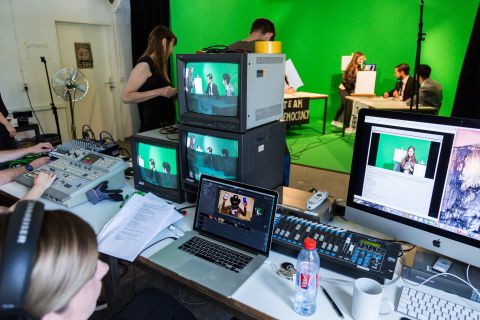
Virtual reality lab, photo studio, printing workshops, greenbox and sound studio - the workshops and labs are open for all students. In addition, the Merz Akademie offers extensive rental equipment for photography, filming, sound and lighting, including disco balls. In the university's own library you will find extensive specialist literature on all fields of study and a well-stocked media library with films and videos. Regular investments ensure that the equipment is always up to date.
On the campus in the Kulturpark Berg in the east of Stuttgart, the Merz Akademie offers the best working conditions. Student flat-sharing communities create an intensive atmosphere that encourages study, creative work and social life. Many creative people are based here, Merz Berufskolleg für Grafik-Design and the Haus des Dokumentarfilms, too.
Students who complete their Bachelor's degree can go on to study for a Master of Arts at the Merz Akademie. With the cross-media Master's degree program Research in Design, Art and Media, the Merz Akademie offers an English-language program that promotes language skills and strengthens the international focus. The Master's degree program Research in Design, Art and Media - Designing the Future offers great freedom in the design of the curriculum and the media design of one's own worldbuilding or documentary practice.
In order to enable as many good applicants as possible to study at the Merz Akademie, there are a scholarship programme: The Deutschlandstipendium amounts to 300 euros per month for two semesters. Scholarships are grants that do not have to be repaid. An overview of other scholarships and funding opportunities for students from Germany and abroad is provided by the Studierendenwerk Stuttgart and the DAAD, among others.
The investment in studying is worth it. How do we know? The Merz Akademie regularly takes part in a nationwide graduate study conducted by the Institute for Applied Statistics (ISTAT). Questions asked include the evaluation of the range of courses on offer, student satisfaction and the professional situation after graduation. In comparison, the graduates of the Merz Akademie have had significantly better experiences in many fields than their fellow students at other design colleges and art academies.
Even after graduation, graduates like to stay in contact with Merz Akademie, are informed about events and news from the university via the newsletter, exchange information on online portals and meet up at the end-of-semester exhibition. Students, alumni, lecturers and the entire university benefit from the mutual exchange and experiences from work, science, research and teaching. Following the transfer of the alumni association into a free network for all alumni, the more than 2,000 alumni will remain connected to Merz Akademie and to each other in the long term.