This talk will present my new book that has just been published. The book explores how data and artificial intelligence abstract people into new kinds of subjects. It argues that digital subjects are not extended selves but abstractions that operate at a distance from us, where agency seems to be removed from our reach but which is also a condition for the possibility of agency. Modelled and predicted, abstract subjects do not have untroubled correspondence to actual living people. They are not us, and yet they are no one else than us. How is it possible?
To come back to us, digital subjects engage our desire. We come to desire these abstractions that offer us objective truths about us and the world, to be recognized or otherwise dealt with subjectively. Thus, we inhabit abstractions through desire and as ideals. The book argues that the intersections of data patterns, computational models and scientific frameworks formulate ideals as possibilities for kinds of personalized and yet still group subjects. Desiring the ideal subjects of AI (such as those of profiling) is simple because we are already trained to desire abstractions such as the normal and the best or be undone by them. The ideal then is about how abstractions are used and how people live by them, becoming as subjects.
Finally, ideal, abstract subjects get grounded by using modernity’s imaginary that there are “real” people, “down there”, underneath the proliferation of probable subjects, constructing the body as an anchor and arranging data worlds into one singularly possible reality.
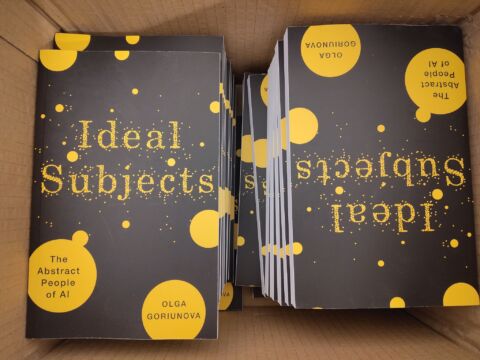 Olga Goriunova: "Ideal Subjects"